Record etiketine sahip kayıtlar gösteriliyor. Tüm kayıtları göster

23 Ocak 2014 Perşembe

Retail e-commerce spending for the November – December 2011 holiday season (November 1 - December 31) increased 15 percent, year-over-year, to $37.2 billion, an all-time record for the season, according to comScore, a company that measures digital data and provides digital business analytics.

Ten individual spending days surpassed $1 billion in sales, as compared to just one day reaching that mark in 2010, the Reston, Va.-based company said. Cyber Monday (the Monday after Thanksgiving Day, November 28) ranked as the heaviest online spending day of the year at $1.25 billion, the second consecutive year it has ranked first for the season. The second heaviest spending day was Monday, December 5 at $1.17 billion, followed by Monday, December 12 at $1.13 billion. Tuesday, November 29 ($1.11 billion) and Tuesday, December 6 ($1.10 billion).

With the relative newness and growing acceptance of digital e-commerce, it’s common for online sales to exceed the prior year’s results. However, the 2011 holiday season was exceptional by any standard.

“With brick-and-mortar holiday retail estimated to have grown about 4 percent this year, it’s clear that e-commerce continues to gain market share from traditional retail due to the attractiveness of the Internet’s convenience and lower prices,” said Gian Fulgoni, comScore chairman. “Consumers were especially attracted to the deals and discounts available through digital channels—particularly free shipping, which occurred on well over half of transactions this season. Despite their continuing price sensitivity, consumers felt a bit more comfortable opening up their wallets this year, although this appears to have occurred as a result of a decline in the savings rate. Nonetheless, it’s clear that, at least on the basis of top line growth, this was a Merry Christmas for many online retailers. What will remain unknown until retailers report their financial year end results is whether the aggressive pricing and free shipping offers came at the cost of lower margins.”
Swatch Times Square store.

Swatch Group saw its 2011 gross sales increase 21.7 percent, year-over-year, to 7.14 billion Swiss francs ($7.5 billion) with December 2011 posting the strongest month in sales in company history.

The world’s largest watchmaker shrugged off the impact of the strong Swiss franc, which negatively affected sales by 10.8 percent. “Despite this extremely negative currency effect, sales in CHF increased by an impressive 10.9 percent over the previous record year 2010,” the company said.

The company also noted that “despite enormous pressure on margins due to the catastrophic currency situation,” it expects 2012 to be another good year for operating profit and net income.

Swatch’s Watches & Jewelry segment recorded an increase in sales of 26.1 percent at constant rates to 6.312 billion Swiss francs ($6.65 billion). Greater China was a very strong market bu the company said it “experienced significant growth” in all regions and price segments. “Investment in retail activities as well as numerous marketing offensives throughout the world contributed to these gratifying sales figures,” the company said.

The brand’s Production segment, where it provides watch components to other watch companies, reported a 32.6 percent increase in sales to 2.015 billion Swiss francs ($2.12 billion) due to “an enormous increase in demand for all types of components. Despite an expansion of production capacity, there were and still are major production bottlenecks,” the company reported.

The Electronics Systems segment mainly felt the effects of the overvalued Swiss franc against the US Dollar and the downtrend in certain key markets. Gross sales fell 16.3 percent to 336 million Swiss francs ($354.1 million).

“Despite the strongly negative currency impact during the course of the year and our traditionally defensive policy concerning price increases, Group Management expects good results for operating profit and net income,” the company said in its report. “The Swatch Group is confident of again generating qualitative growth in 2012, despite the ever more challenging comparison basis.”

13 Ocak 2014 Pazartesi

The 9-ct. Belle Epoque cushion-cut, fancy vivid purplish pink diamond ring from the estate of Huguette M. Clark sold for $15.7 million.

NEW YORK — A 9-carat pink diamond from the estate of Huguette M. Clark sold for more than $15.7 million, after intense, competitive bidding that led to an eruption of applause on the crowded auction floor at Christie’s Tuesday. It is the most valuable pink diamond ever sold in the United States at auction, according to the auction house.

The Belle Epoque cushion-cut, fancy vivid purplish pink diamond, known as “The Clark Pink,” was estimated to fetch $6 to $8 million. Clark, one of the last heiresses of America’s Gilded Age, died in May, 2011, at the age of 104. Her collection of 12 lots drew intense intentional attention because she lived a reclusive life in her later years and her jewels were believed to have been kept in a vault unseen since the 1940s.

The entire collection, which included picture frames, a clock, an American flag lapel and jewelry pieces by Cartier and Tiffany, took in a total of $20.8 million against a presale estimate of $9 million. Other significant items from the estate sale included:

* A 19.86-carat rectangular-cut diamond ring by Cartier that sold for $3.1 million;
* An Art Deco diamond bracelet by Cartier that sold for $578,500; and
* A ruby, sapphire, emerald and gold bracelet by Tiffany & Co. that sold for $266,500.

More images of the Clark estate jewelry can be found by following this link.

The collection was part of Christie’s Magnificent Jewels sale Tuesday that had 305 lots that included signature jewels, items from several estates and serious diamonds. It took in a total $70.7 million, with 95 percent of the items sold by lot and 97 percent of the estimated price realized.

More on other significant sales from the auction later today.

3 Ocak 2014 Cuma

Christie’s employees taking phone bids during The Collection of Elizabeth Taylor auction at Christie’s New York. Photo credit: Christie’s

As the 2012 London Summer Olympics winds down, it got me thinking about some of the great moments in history as it pertains to jewelry, gemstones and precious metals. Wealth and power throughout time has often been measured in the ownership of the most valuable and desirable adornment. Often the stories of precious ornaments ran alongside the rise and fall of kingdoms. Below is just short listing of some of the milestone moments. Please feel free to add more.

* The Most Valuable Sale of Jewelry in Auction History. “The Collection of Elizabeth Taylor” auction held at Christie’s New York in December 2011. Following a worldwide tour and a 10-day exhibition at Christie’s New York, the two-day sale of Ms. Taylor’s jewelry took in approximately $137.2 million. The opening night jewelry sale (December 13) alone set seven world auction records for some of the most important jewels in the world, including:

La Peregrina. Photo credit: Christie's

- The World Auction Record for a Pearl Jewel. “La Peregrina,” one of the most famous pearls in the world with a history that spans 500 years, on a necklace designed by Cartier for Taylor, sold for $11.8 million. It is believed to have been found by an African slave on the coast of the isle of Santa Margarita in the Gulf of Panama in the mid-16th Century or as early as the 15th Century. This pear-shaped pearl of 203 grains in size—equivalent to 55 cts.—became part of the crown jewels of Spain. Prince Philip II of Spain gave it as a wedding gift to his wife, Mary Tudor of England. It was passed on to the Spanish queens Margarita and Isabel, who wore the pearl in 17th century portraits painted by Velázquez. Richard Burton famously purchased the pearl for Elizabeth Taylor at auction in 1969 for $37,000, after successfully outbidding a member of the Spanish Royal family. Burton gave the pearl to Taylor on Jan. 23, 1969. Inspired by a 16th century portrait of Mary Queen of Scots, who wore it as a pendant to a brooch, Taylor commissioned Cartier to design a new mount of matched natural pearls and rubies, designed by Al Durante.

Elizabeth Taylor Diamond. Photo credit: Christie's

- The World Auction Record for a Colorless Diamond Per Carat. The Elizabeth Taylor Diamond (also known as the Burton-Taylor Diamond). The 33.19-carat Asscher-cut D color potentially flawless diamond sold for more than $8.8 million, or $265,697 per carat. The 33.19-ct., D color, potentially internally flawless diamond mounted on a ring was a gift from Richard Burton on May 16, 1968. The most iconic of her cherished white diamonds, it became the ring Ms. Taylor wore almost every day. The Type IIa diamond was purchased at auction for $300,000 in 1968 as the Krupp diamond. It is also known as the Taylor-Burton diamond.

Taj Mahal Diamond. Photo credit: Christie's

- The World Auction Record for an Indian Jewel. The heart-shaped Taj Mahal Diamond that sold for more than $8.8 million. Inscribed with the name Nur Jahan, the wife of the Mughal Emperor Shah Jahangir, this heart-shaped diamond is believed to have been a gift from the ruler to his son, who became the great emperor Shah Jahan (1592-1666). At the age of 35, it is believed that the young prince presented the diamond to his favorite and most beloved wife, Mumtaz-i-Mahal. The emperor’s grief at her death just four years later was legendary—in her memory he commissioned the majestic Taj Mahal. Richard Burton gave it to Ms. Taylor in 1972 for her 40th birthday.

Joseph Asscher Photo credit: Royal Asscher

* The World’s Largest Rough Diamond. The 3,106-carat Cullinan diamond uncovered in 1907 by Frederick Wells at the Premier Mine in Pretoria, South Africa. Wells presented the diamond to Sir Thomas Cullinan, who owned the mine. Cullinan then sold the diamond to the Transvaal provincial government, which presented the stone to Britain's King Edward VII entrusted the cutting of the Cullinan to Joseph Asscher, head of the Asscher Diamond Company of Amsterdam. Asscher studied the stone for six months before attempting the cut. Legend has it that on his first attempt, the steel blade broke, with no effect on the diamond. On the second attempt, the diamond shattered exactly as planned; Asscher then fainted from nervous exhaustion. Lita Asscher, president of Royal Asscher of America and sixth generation heir to the family business, says her family has their own spin on the story: “We always say that he did not faint. He drank too much champagne (after cutting the diamond) and then he fainted.”

"Star of Africa I," or "Cullinan I" Photo credit: Royal Asscher

* The World’s Largest Cut Diamond. The Cullinan was later cut into nine large stones and about 100 smaller ones. The largest stone is called the "Star of Africa I," or "Cullinan I," and at 530 carats, it is the largest-cut fine-quality colorless diamond in the world. The second largest stone, the "Star of Africa II" or "Cullinan II," is 317 carats. Both of these stones, as well as the "Cullinan III," are on display in the Tower of London with Britain's other crown jewels; the Cullinan I is mounted in the British Sovereign's Royal Scepter, while the Cullinan II sits in the Imperial State Crown.

Cullinan I was the largest diamond in the world until 1987. The Golden Jubilee Diamond now has that honor. At 545.67 carats, it outweighs the Cullinan I by 15.37 carats. The yellow-brown diamond in a fire rose cushion cut was purchased from De Beers by a group led by Henry Ho of Thailand and given to Thai King Bhumibol Adulyadej in honor of his 50th coronation anniversary. It is now located in the Royal Thai Palace as part of the crown jewels.

Faberge Siberian aquamarine and diamond brooch was a gift from Tsar Nicholas II to princess Alix of Hesse. They were executed July 17,1918, and she was wearing the jewel right up until the time of her death. Photo credit: Anthony DeMarco

The World’s Best Story Attached to a Piece of Jewelry. A Siberian aquamarine Fabergé brooch that Russian Tsar Nicholas II gave to princess Alix of Hesse as an engagement gift. I saw this piece at Wartski jewelry antique store in London, best known as the “royal warrant of appointment,” one of a handful of companies that supply goods and services to the British Royal Family. Geoffrey Munn, the store’s managing director Fabergé told the story behind the brooch:

In here we have a Fabergé brooch, a Siberian aquamarine surrounded by diamonds. That’s all we knew for a while. It’s an exemplary aquamarine and it’s of extraordinary color. (women in the group gasp with amazement). I know, I know it’s fabulous. (But) it’s only the beginning of the trouble. Because this really is going to wreck you and you’ll need a stiff drink afterwards. It’s an exemplary aquamarine and it’s a Siberian one and they don’t really come in that color unless they do come from Siberia.… The story of this is really quite awe inspiring because the color blue in the lore of lapidary stones stands for love and then there’s sort of the interlock of two lives with diamonds forever. And that’s all we knew for a very long time until my colleague sent off the number to Russia and back came the provenance and it said that it was bought by the Supreme Autocrat of all the Russias—a pretty hot title—and there’s a note beside it saying it was the engagement present from (Russian Tsar) Nicholas II to princess Alix of Hesse. And that is sort of stratospheric. But then what happens later is even more heartbreaking because when they were taken to prison in Siberia (during the Bolshevik Revolution), they went to a place called The House of Special Purpose—a very menacing title—and you know what happens next but this (the jewel) was with her just before she was taken to the basement and riddled with gunfire. It was confiscated and it isn’t actually open to debate because it was a civil service theft and so they made an inventory of what they’ve taken from her and they photographed it on the table so you don’t hear any fanciful stories. I think possibly that’s as far as jewelry will ever take you.

Tsarevna Swan

* Most Diamonds Set on a Single Ring. Could this be an object that will hold a history of its own? The “Tsarevna Swan,” a tall, highly stylized 18k white gold ring set a Guinness World Record for having the most cut diamonds on a ring: 2,525. It was unveiled in 2011 by the Lobortas Classic Jewellery House of Kiev, Ukraine. Regardless of whether this will capture the imagination of future generations of jewelry collectors, it is a great accomplishment.

As I mentioned, you are welcome add anything that I have missed.

28 Aralık 2013 Cumartesi

The 76-carat diamond is considered is the largest D-color, Internally Flawless diamond from the historic Golconda region. It was the property of the Archduke Joseph August of Austria, Palatine of Hungary (1872-1962). Photo credit: Tony Falcone

A large, D-color, Internally Flawless diamond with outstanding pedigree in origin and ownership sold for $21.5 million at Christie’s Geneva Magnificent Jewels auction on Tuesday, setting a world record for the sale of a colorless diamond.

The 76-carat Archduke Joseph Diamond was sold to a phone bidder during the auction held at the Four Seasons Hotel des Bergues, Geneva. The unmounted, cushion-shaped gem is from the historic Golconda region of India, one of the oldest diamond mining regions in the world and where some of the most storied diamonds on earth were discovered. The Gemological Institute of America said it is the largest D-color, IF diamond it ever graded from the historic region. It was the property of the Archduke Joseph August of Austria, Palatine of Hungary (1872-1962), a member of the House of Habsburg. 

“I am thrilled but not surprised that the Archduke Joseph Diamond should have fetched such a high price,” said the former owner of the diamond, Alfredo J. Molina, CEO of America’s Black, Starr & Frost jewelers. “I was blessed to be the Archduke’s guardian and champion for the past 13 years, and indeed it has become part of my very identity.”

The auction took in more than $85 million, selling 84 percent by lot and 86 percent by value. This result, combined with the total achieved for the category in May, concludes the most successful year for Christie’s jewelry department in Switzerland, with annual sales exceeding $195.2 million.  

Highlights of the sale include: 


A Pair of Unmounted Brilliant-Cut Diamonds. The twin gems sold in separate lots each for $2.1 million. The diamonds were each 25.28 carats and have identical G color, VVS1 clarity characteristics. Each gem also has the same estimate of $2.3 million to $2.5 million.

Photo Credit: CHRISTIE'S IMAGES LTD. 2012

Colored Diamond and Diamond Brooch by Wartski. The shield shaped fancy intense blue diamond center, SI1clarity, weighing approximately 3.33 carats, flanked on either side by single old-cut pear-shaped diamonds with a suspended diamond. Wartski, the London antique jeweler, is a “royal warrant of appointment” for the British Royal Family. Estimate: $1 million - $1.4 million. Sold for $2.4 million.

Photo Credit: CHRISTIE'S IMAGES LTD. 2012

Sapphire and Diamond ‘Transcendence’ Butterfly Brooch by Cindy Chao. The body of the pavé-set diamond butterfly is a pentagonal-cut diamond, weighing approximately 3.01 carats, the wings are enhanced by briolette diamonds, sapphire beads and vari-cut sapphires. It is mounted in titanium and gold and signed by artist.

Photo credit: Denis Hayoun - Diode SA

Bulgari Art Deco Sapphire and Diamond Sautoir. The circa 1930s baguette and circular-cut diamond geometric pendant is centered upon a star sapphire, suspended from a sautoir composed of cabochon sapphire and diamond cluster panels with diamond collet connecting links. Estimate: $320,000 - $530,000. Sold for $662,483.

A 70-carat unmounted rectangular-cut fancy vivid yellow diamond failed to sell. It had an estimate of $3.1 million to $5 million. 

Please join me on the Jewelry News Network Facebook Page, on Twitter @JewelryNewsNet and on the Forbes Web site.


The Duc d’Orléans Breguet Sympathique clock set a new auction record for any clock and the second-highest price for any timepiece at auction when it sold for more than $6.8 million at Sotheby’s New York Important Watches & Clocks Auction on Tuesday.

The distinguished example of the exceptionally rare Sympathique clocks, which helped cement the fame and renown of French watchmaker Abraham-Louis Breguet, was last offered at auction in Sotheby’s 1999 when it sold for $5.7 million. This price has remained the auction record for any clock until Tuesday’s sale.

Invented by Breguet in 1795 and presented to the public for the first time at the Exposition Nationale des Produits de l’Industrie in 1798, the sympathique clock was a system consisting of a clock and a watch. The clock was designed to hold the watch in its cradle, where it was automatically adjusted and rewound. The term sympathique was chosen by Breguet to express the notion of harmony and concord.

The Important Watches & Clocks auction totaled more than $11.6 million marking the highest result for a various-owners sale of watches and clocks at Sotheby’s New York, the auction house said in a statement. In addition to the Sympathique, both vintage and modern wristwatches by Patek Philippe dominated the day’s top results, led by a rare 46 mm 18K Yellow Gold Center Seconds Wristwatch, 1955, Ref 2512/1 that achieved $962,500, more than five times its high estimate of $150,000.

Please join me on the Jewelry News Network Facebook Page, on Twitter @JewelryNewsNet and on the Forbes Web site.


18 Aralık 2013 Çarşamba

L’Incomparable World's Most Valuable Necklace.

Guinness World Records has named Mouawad’s L’Incomparable diamond necklace as the world’s most valuable necklace, according to media reports. The 637-ct. necklace is valued at $55 million.

The statement gem on the 18k gold necklace is the 407.48-ct. “Incomparable” diamond. The natural fancy deep-yellow shield step‐cut diamond is the largest internally flawless diamond ever graded by the Gemological Institute of America.

The remainder of the necklace consists of 35 round diamonds, 27 pear-shaped diamonds, nine heart-shaped diamonds, five emerald-cut diamonds, five cushion diamonds, four oval diamonds, three Asscher-cut diamonds and two radiant diamonds.

As previously reported, the luxury jewelry and timepiece company unveiled the diamond necklace at the Doha Jewellery and Watch Exhibition, which was held February 25 – March 3. It is the fourth Guinness World Record the company has earned.

In its rough state, the diamond weighed 890 carats. It was first made public in its polished state in 1984. It was then put on display in several museums, with the first being the Smithsonian Institute.  

Please join me on the Jewelry News Network Facebook Page, on Twitter @JewelryNewsNet and on the Forbes Website.

15 Aralık 2013 Pazar

The 34..65-carat Princie Diamond

Update: A 34.65-carat fancy intense pink cushion-cut diamond sold for more than $39.3 million at Christie’s New York Spring Magnificent Jewels auction Tuesday.The sale price represents a new record for any jewel sold at Christie’s, surpassing the previous house record of $24.3 million set in December 2008 with the sale of the Wittelsbach Diamond.

Known as the Princie Diamond, its origins can be traced back to the ancient diamond mines of Golconda in South Central India. It was first recorded among the holdings of the Royal family of Hyderabad, rulers of one of the wealthiest provinces of the Mughal Empire.

The sale price, which comes out to more than $1.1 million per carat, also set a record for being the most valuable diamond to ever come out of the famed mine, according to the auction house. It was purchased by an anonymous collector bidding by phone.

“A major event took place in the global auction industry with the record breaking sale of The Princie Diamond at Christie’s New York,” said Rahul Kadakia, Head of Jewelry, Christie’s Americas and Switzerland.

The Type IIa diamond, considered the most chemically pure and often having exceptional optical transparency, was first offered at auction in 1960 as “Property of a Gentleman,” who was later revealed to be the Nizam of Hyderabad himself. The diamond was purchased by the London branch of Van Cleef & Arpels for £46,000. The diamond’s unique name was bestowed at a party at the firm’s Paris store, where it was christened the “Princie” in honor of the 14-year-old Prince of Baroda, who attended the party with his mother Maharani Sita. 

 The total sale of over 290 jewels realized a combined total of more than $81.35 million, "marking the highest various owner jewelry sale total in the United States," according to the auction house.

"Aside from Christie’s sale of the legendary Collection of Elizabeth Taylor, this was the most successful jewelry auction ever held in the United States,”
Kadakia said.

Other highlights of the sale, which marked the first jewelry sale of the spring season for Christie’s, included:


* A 30.32-carat rectangular-cut diamond ring (pictured above) that sold for more than $4.4 million, well above its high estimate of $4 million. The diamond set on a platinum ring is flanked on either side by a tapered baguette-cut diamond.

* A 23.30-carat marquise-cut diamond, flanked on either side by a tapered baguette-cut diamond, mounted in platinum sold for nearly $3.26 million.

* A necklace designed as a graduated cluster of pear and oval-cut diamonds mounted in platinum by William Goldberg sold for nearly $1.86 million.

* A ring centered with an 11.08-carat, oval-cut ruby surrounded by two rows of circular cut diamonds mounted on platinum sold for more than $1.7 million.

* A 35.60-carat cut-cornered modified rectangular-cut fancy pink-brown diamond mounted in platinum and 18k pink gold sold for more than $1.6 million. The diamond was flanked on either side by a tapered baguette-cut diamond.

* A diamond necklace suspending a pendant set with a pear-shaped diamond weighing approximately 12.04 carats sold for nearly $1.4 million, well above its high estimate of $1.1 million.


* An 11.39-carat rectangular-cut diamond mounted on a platinum ring (pictured above) sold for more than $1.3 million.
 

* An emerald and diamond necklace by Harry Winston (1955) that sold for $1.2 million (pictured above). It was designed as a graduated double row of rectangular-cut emeralds, extending a pear and circular-cut diamond fringe, joined by circular and pear-shaped diamond clusters to the circular-cut diamond double row backchain, mounted on platinum.
 

* A 17.5-inch, three-strand natural pearl necklace comprising 61, 58 and 61 natural pearls, measuring from approximately 4.95 to 11.05 mm sold for $1.1 million (pictured above).

* A 37.47-carat rectangular-cut diamond, flanked on either side by an epaulette-cut diamond and mounted in platinum sold for more than $1.1 million.

Please join me on the Jewelry News Network Facebook Page, on Twitter @JewelryNewsNet and on the Forbes Web site

A 74.79-carat, pear-shaped diamond sold for more than $14.1 million at Sotheby’s New York Magnificent Jewels sale Wednesday, setting a new auction record for any white diamond sold in the Americas and surpassing its $12 million high estimate.

The unnamed gem is one of very few pear-shaped diamonds of D color over 50 carats to be auctioned in recent decades, Sotheby’s said.

“The truly exceptional 74.79 carat stone was a thrill to auction, and exemplifies the strength of the market for white diamonds over the last decade,” said Lisa Hubbard, chairman, North & South America, Sotheby’s International Jewelry Division. “It was acquired by the present owner in 2001 for $4.3 million, and today sold for a record $14.2 million.”

The Magnificent Jewels sale brought in nearly $53.5 million, marking a new record sum for a spring auction of jewelry at Sotheby’s New York, with more than 82.4 percent sold by lot.

A group of six jewels from the family of financier and railroad magnate Jay Gould sold for a combined $7.9 million, more than double its high estimate of $3 million. The group was led by an emerald and diamond brooch centered by a 22.48-carat Colombian emerald that sold for $2.9 million– nearly five times its high estimate of $600,000.

Cartier’s ‘Tutti-Frutti’ bracelet (circa 1930), made of platinum, carved rubies and emeralds, diamonds and pearls, which closed the sale, sold for $1.4 million, nearly three times its high estimate of $500,000.


Please join me on the Jewelry News Network Facebook Page, on Twitter @JewelryNewsNet and on the Forbes Website.

12 Aralık 2013 Perşembe

Gina Lollobrigida wearing the diamond necklace/bracelet combination, Bulgari, 1954, as a tiara and the record-breaking natural pearl and diamond pendant earrings.

Jewels belonging to movie legend Gina Lollobrigida sold at Sotheby’s Geneva Tuesday for more than $4.9 million (including buyers’ premium), smashing the high estimate of $3.2 million.

The star of evening was a pair of natural pearl and diamond pendant earrings, believed to have been owned by the House of Habsburg, which sold for nearly $2.4 million—an an auction record for a pair of natural pearl ear pendants, beating the figure set by Elizabeth Taylor’s pearl earrings in 2011. Lollobrigida wore those earrings on numerous landmark occasions in her career.

Buyers from around the world also clamored for seminal pieces from the 1950s and 1960s by Bulgari, the auction house said. Lollobrigida is donating her proceeds from the sale to benefit stem cell research. Among the highlights:

* A diamond necklace/bracelet combination, Bulgari, 1954, which realized $783,851, well above the $500,000 high estimate. The necklace was identified by Daniela Mascetti as one of Bulgari’s most important creations in her book Bulgari. Lollobrigida was seen wearing this jewel on key moments in her professional and personal life, including when she received her 1961 Golden Globe for World Film Favorite – Female.

* A diamond ring set with a cushion-shaped diamond weighing 19.03 carats, Bulgari, 1962, which brought $783,851.

* A pair of emerald and diamond earclips, Bulgari, 1964, which sold for $306,633.

* An emerald and diamond ring, Bulgari, 1964, set with a step-cut emerald weighing 16.62 carats which fetched $181,050.

View Gina Lollobrigida’s jewels in the Sotheby’s Geneva auction.

Speaking after the sale, Lollobrigida said: “Jewels are meant to give pleasure and for many years I had enormous pleasure wearing mine. Many people tried to persuade me to sell them, but for a very long time I was unwilling. What changed was seeing a little girl called Sofia suffering from a disorder, which could only be helped by stem cell treatment—treatment which she is unable to receive in Italy. Selling my jewels to help raise awareness of stem cell therapy, which can cure so many illnesses, seems to me a wonderful use to which to put them. It is my hope that the Italian parliament will approve this ground-breaking treatment, so that children and adults in Italy should have free access to it without having to travel abroad at great expense. It now gives me great pleasure to see that these jewels will create a legacy which will live on after me and continue to do good.”

Lollobrigida’s collection was the centerpiece of Sotheby’s Magnificent and Noble Jewels sale Tuesday, which saw nearly 650 lots selling for a combined total of $78.2 million. 

Please join me on the Jewelry News Network Facebook Page, on Twitter @JewelryNewsNet and on the Forbes Website.

2 Aralık 2013 Pazartesi


A 14.82-carat fancy vivid orange diamond set two world records as it sold for more than $35.5 million at Christie’s Geneva Magnificent Jewels sale held Tuesday.

Simply called “The Orange,” the gem set a world record for a fancy vivid orange diamond. And at $2,398,151 per carat, it also set a world record price per carat for any colored diamond sold at auction. It shattered its high estimate of $21 million.

“Time and again, a stone will appear on the market that is truly a miracle of nature,” said François Curiel, International head of Christie's Jewellery Department. “The 14.82-carat orange diamond is one such a stone, a rare gem, which will perhaps only be seen once in a lifetime. In the sale on Tuesday, it soared far above all previous records for any orange diamond ever sold at auction, placing The Orange among the greatest pinks and blues, which are traditionally the most appreciated colored diamonds.”

There was little question that the diamond was going to fetch a record price. It is believed to be easily the world’s largest orange diamond. It is approximately three times larger than the two other known large orange diamonds: The 5.54-carat “Pumpkin Diamond,” which was sold privately, and a 4.19 carat fancy vivid orange diamond sold at auction for a record price of $2.95 million in October 2011.

It was the last of the 286 lots that were up for sale at the auction held at the Four Seasons Hotel des Bergues. 

The bidding opened at 10 million Swiss francs and quickly reached $20 million francs before the bidding slowed and the increments of bids switched from 1 million francs to a half-million. It appeared on the Christie’s live Internet feed that several bidders were in the room competing with those on the phones. Applause followed the winning bid of 29 million francs ($31.6 million). The final total of $35,531,974 million includes fees and commissions.

Pure orange diamonds are exceptionally rare, the auction house said. It is more common to find orange diamonds with secondary colors. The orange color is the result of the presence of nitrogen during the diamond’s creation.

The Gemological Institute of America, which graded the diamond and issued its report, recently said: “Strongly colored diamonds in the orange hue range rarely exceed three or four carats in size when polished. (This diamond) is almost four times larger than that size range. In GIA’s colored diamond grading system, as the color appearance of strongly colored diamonds transitions from orangy yellow to orange the occurrence becomes progressively more rare—that is—the less yellow present the more rarely they occur.”

In the GIA report, the diamond was graded as VS1 clarity, and classified as a Type IA.

Please join me on the Jewelry News Network Facebook Page, on Twitter @JewelryNewsNet and on the Forbes Website.

1 Aralık 2013 Pazar


The June Hong Kong Jewellery & Gem Fair had 25,925 visitors from 113 countries and regions and 1,841 exhibitors from 37 countries and regions—both new records. Overseas visitor attendance at the tradeshow held June 20 - 23 at the Hong Kong Convention and Exhibition Centre was up about 5 percent from 2012.

This year, additional space was made available to accommodate more gemstone exhibitors, expanding the amount of exhibition space in the convention center to 64,000 square meters.

Among the highlights of the event:

* Nearly 11,000 visitors from Hong Kong, accounting for 39 percent of the total number of visitors. The rest of the visitors, 15,751, or 61 percent, were from overseas.

* The largest group of visitors from outside Hong Kong came from mainland China with 8,029; followed by India (894), Taiwan region (791), the Philippines (627), and the United States (537).

“The robust jewelry markets in Asia are filling some of the gap brought about by the weakness in the European and US markets,” said Celine Lau, director of Jewellery Fairs, UBM Asia. “This year, we again saw a double-digit growth in the number of buyers from the mainland China. This figure illustrates the continued strength of the country’s jewelry market and its potential for further growth.”


Please join me on the Jewelry News Network Facebook Page, on Twitter @JewelryNewsNet and on the Forbes Website.

29 Kasım 2013 Cuma


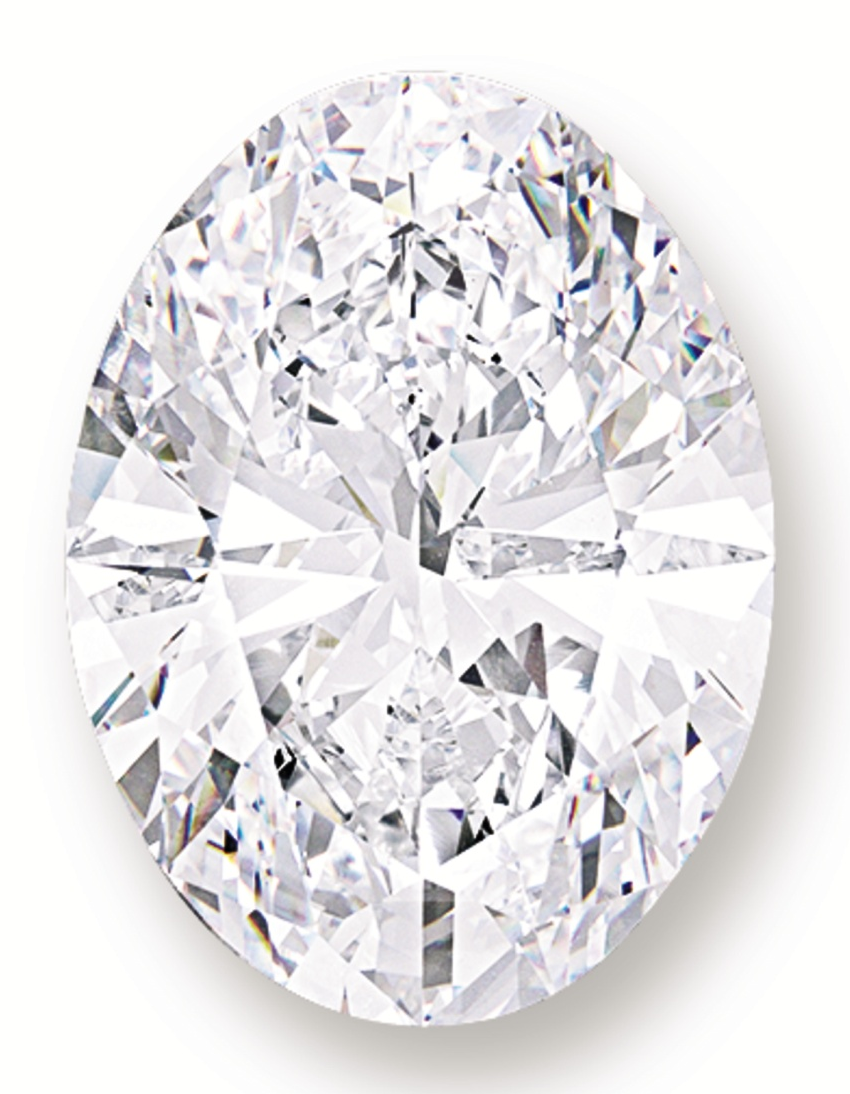
A 118.28-carat D-flawless diamond fetched $30.06 million at Sotheby’s Hong Kong Magnificent Jewels sale Monday. It is a world record price for any white diamond at auction. 

The unmounted, oval-shaped diamond is the largest white diamond ever sold at auction and the largest oval D-flawless diamond in the world as graded by the Gemological Institute of America. GIA graded the diamond, reportedly about the size of an egg, as D color, flawless clarity, with excellent polish and symmetry. The diamond was also graded as a Type IIa, making it among the most chemically pure type of diamond with exceptional optical transparency.

The diamond was cut from a 299 carat rough diamond discovered in 2011 from a mine in Southern Africa.


However, there was a disappointment for the evening as a 7.59-carat round fancy vivid blue diamond failed to sell. Known as the Premier Blue, this brilliant-cut internally flawless gem is the largest round fancy vivid blue diamond ever graded by the GIA. Sotheby’s said the round brilliant cut is rarely used in colored diamonds due to the high waste involved in the cutting process. The diamond is mounted on a platinum ring and surrounded by brilliant-cut pink diamonds together weighing approximately 1.70 carats.

The auction held at the Hong Kong Convention and Exhibition Centre took in nearly $95.5 million, making it the highest total for a sale of jewelry in Asia.

In addition to diamonds, jadeite was very popular during the sale. The top item in this category was a double-strand jadeite bead necklace that sold for more than $5.4 million.

Please join me on the Jewelry News Network Facebook Page, on Twitter @JewelryNewsNet and on the Forbes Web site.

The 59.6-carat Pink Star diamond lived up to its hype by selling for a world record price of approximately $83.4 million at Sotheby’s Geneva Magnificent Jewels sale Wednesday.

When introducing the internally flawless fancy pink vivid diamond, David Bennett, chairman of Sotheby’s Jewellery Division in Europe and the Middle East, called it “one of the most remarkable gems to ever appear at auction.”

Bidding opened at 48 million Swiss francs and gradually climbed to 64 million Swiss francs. After a pause it quickly climbed to 67 million francs ($73.2 million), shattering its $60 million high estimate. Nervous laughter could be heard on Sotheby’s live feed as the bidding slowly pushed up to the winning bid 68 million Swiss francs. Commission fees pushed the final total to more than 76.3 million Swiss francs ($83.4 million).

The diamond is graded as Type IIa, which is rare for any pink diamond, much less one of this size and color. Cut over a period of two years, The Pink Star is more than twice the size of the Graff Pink—a 24.78-carat fancy intense pink diamond that established a world auction record for a diamond and any gemstone or jewel at $46.2 million, at Sotheby’s Geneva in 2010. The current record price per carat for a fancy vivid pink diamond of $2,155,332 is set by a 5-carat diamond, sold in Hong Kong in January 2009. The current record price for any colored diamond sold at auction is $2,398,151 per carat, for “the Orange,” a 14.82-carat fancy vivid orange diamond that sold a day earlier at Christie’s Geneva Magnificent Jewels auction. The per carat price for the The Pink Star has yet to be released and will be updated.

Cut by Steinmetz Diamonds over a period of nearly two years from a 132.5-carat rough, the diamond was first unveiled to the public in May 2003 as the “Steinmetz Pink.” The stone was first sold privately in 2007 and renamed The Pink Star.

 Please join me on the Jewelry News Network Facebook Page, on Twitter @JewelryNewsNet and on the Forbes Website.

28 Kasım 2013 Perşembe


The earliest and most significant example of a Patek Philippe Grand Complication sold for more than $2.25 million Tuesday at Christie’s New York Important Watches auction—well above its $1.5 million high estimate. The price represents a world auction record for a Patek Philippe Grand Complication.

The Stephen S. Palmer Patek Philippe Grand Complication No. 97912 is a minute repeating perpetual calendar split-seconds chronograph clockwatch with grande and petite sonnerie and moon phases, manufactured in 1898. It has never been seen in public and it was the first time it ever appeared on the auction block. 


The definition of Grand Complication is often debated among watch experts and collectors, but it is generally agreed that it features the following: Grand and Petite Sonnerie, Perpetual Calendar and Moon Phases, and Split-Seconds Chronograph.

Until the appearance of the 18k pink gold Palmer watch, it was broadly accepted that Patek Philippe did not make its first Grand Complication until 1910 and that the second ever made was reserved before World War I for James W. Packard in 1916, Christie’s said recently.


With all of the avid collectors of important watches, the historical watch experts, and the way that luxury watch companies maintain their historical data—how could such a rare and valuable watch be unknown? Last night I attended a panel presentation on Grand Complications at the Aaron Faber Gallery in New York and was told by two of the panelists that this type of thing does occasionally happen. Michael Friedman, an historical watch expert, explained to me that being in a private collection the watch was unknown. In addition, even if Patek Philippe has the information in its archives it would not have released it unless asked.

The watch was purchased on Oct. 3, 1900, for 6,500 Swiss francs by Stephen S. Palmer. The original certificate and presentation box were included in the sale.

The sale of 361 lots totaled nearly $8 million. 


Please join me on the Jewelry News Network Facebook Page, on Twitter @JewelryNewsNet and on the Forbes Website.

27 Kasım 2013 Çarşamba

Photo credit: Shrenuj & Co.

A famed Ukraine luxury jewelry house has made it into the Guinness Book of World Records for creating a ring with more than 2,500 diamonds.

Known as the “Tsarevna Swan,” the tall, highly stylized 18k white gold ring is set with 2,525 diamonds, according to Guinness. It was created by the Lobortas Classic Jewelry House of Kiev, Ukraine, and was presented and measured on July 21, 2011.

Lobortas has set the price of the ring at $1.3 million, according to published reports.

The diamonds range from 0.001-0.05 carats with a total weight of 10.48 carats. All of the diamonds are of G color and range from VVS2 to VS1 in clarity. The diamonds were supplied by Shrenuj Group, a diamond and diamond jewelry manufacturer based in Mumbai, India.

The design and development of the ring took 530 hours and fabrication took 3,625 hours, according to published reports. The ring is currently being shown in Keiv.

26 Kasım 2013 Salı

Francois Curiel Leads the auction Wednesday.

NEW YORK - Nothing could have topped Tuesday night’s $115.9 million jewelry auction of Elizabeth Taylor’s Legendary Jewelry and no one expected that to happen. However, the second and final day of the jewelry sale, held Wednesday at Christie’s New York fetched another exceptional result: $21.3 million.

The two days of marathon auctions achieved the combined total of more than $137.2 million, making it “not only the most valuable private collection of jewelry ever offered at auction, but also the most valuable sale of jewelry in auction history,” the auction house said Wednesday. 

Again, 100 percent of the lots were sold during the eight-hour sale and no more than one item sold for its auction estimate. Sales 10 times the high estimate was the norm. Two items sold for more than $1 million. They are:

An antique garland-designed necklace with suspended natural and rose cut diamonds sold for nearly $1.5 million and was the top lot of the daylong session. The high estimate was $150,000.

The other was the most anticipated piece, the Burton wedding bands. Two eternity bands, the first designed as a baguette-cut diamond eternity band, mounted in gold; the second designed as a circular-cut and single-cut diamond octagonal-shaped eternity band, mounted in white gold. The pair sold for just over $1 million after 15 minutes of intense bidding. The high estimate was $8,000.

“It took eight hours and three auctioneers to sell 190 more jewels from Elizabeth Taylor’s storied collection,” said François Curiel, international director of jewelry at Christie’s. “The atmosphere was electric from the very first to the last lot, with collectors from Asia, the Middle East, Europe and America chasing each individual jewel with a tenacity never seen before.”

Wednesday’s event at Christie’s Rockefeller Center headquarters was more casual than the intense black tie affair Tuesday night, but it had plenty of moments of intense bidding, dramatic pauses and even moments of humor. Like the previous auction estimates were treated as something one needn’t be bothered with.

Online bidders were strongly involved in many items and there were many other bidders on the phone from around the world. Curiel said the spectacular results of the prior night’s sale led to more international interest. Circular cut amethyst with turquoise ear clips led to a battle among three online bidders before selling for $52,500. New Zealand’s name came up during several bids.

Jewelry from the House of Taylor did very well with three lots selling for more than $200,000. Taylor licensed her to the company, which produced fine jewelry at several price points. Rge short-lived company had a spectacular rise and sudden fall in 2008 during the beginnings of the economic recession.

Pieces from many of the luxury jewelry brands associated with Taylor for years (Van Cleef & Arpels, Cartier, Bulgari and others) had another exceptional day.

Bidders whom I spoke with were awestruck by the selling prices over the two days. But they were smiling, knowing that they were part of a once in a lifetime event. Los Angeles-based jewelry designer, Lorraine Schwartz, a friend of Taylor who designed some of her jewelry, tried to buy back one of the pieces. She lost.

“I was thinking like the dealer that I am,” she said. “I just couldn’t bring myself to go higher.”

One of the more unusual lots was a suite of paper jewelry that Forbes founder, Malcolm Forbes, gave to Taylor as a gag gift. It sold for $6,875. Its estimate was $200 to $300. How do you explain this?

The longest and most intense bidding was for the Burton wedding rings, the last lot of the two-day sale. There was several moments of extended silence as Rahul Kadakia, head of Christie’s jewelry department in the Americas, extended the bidding as the price moved up in tiny increments.

When the gavel finally sounded, the audience let out a breath and applauded.