Holiday etiketine sahip kayıtlar gösteriliyor. Tüm kayıtları göster

30 Ocak 2014 Perşembe


Jewelry has returned to many holiday wish lists, a sign that discretionary spending is back in vogue this holiday season, according to a just released survey.

A total of 23 percent of people surveyed will be asking for jewelry this holiday season, a 10 percent jump from last year’s 20.8 percent, according to the National Retail Federation’s 2010 Holiday Consumer Intentions and Actions Survey, conducted by BIGresearch.

Gift cards will remain the most requested holiday gift this year with 57 percent of people asking for plastic, followed by clothing (48.2%) and books (47.3%).

Overall, U.S. consumers plan to spend an average of $688.87 on holiday-related shopping, a slight rise from last year’s $681.83, according to the annual survey.

As in years past, most holiday gift-givers will spend the largest portion of their budget buying gifts for family ($393.55) and friends ($71.45), though they’ll still carve out room in their budget for small tokens of appreciation for both co-workers ($18.26) and others ($34.82). Total spending on gifts ($518.08) is expected to rise 2.1 percent from last year, which is in line with NRF says. Americans will also spend an average of $41.51 on decorations, $26.10 on greeting cards and postage, $86.32 on candy and food, and $16.86 on flowers.

“Consumers will still shop with the economy in the back of their minds, but we’re starting to see shoppers take baby steps toward a new normal,” said, Matthew Shay, NRF president and CEO. “As Americans open up their wallets for more discretionary gifts like jewelry or take advantage of sales to buy for themselves, retailers will begin to truly believe that the worst may be behind them.”

According to the survey, 61.7 percent of shoppers say the economy will impact their spending, down from last year’s 65.3 percent. Many shoppers say they will compensate by spending less (81.5%), comparison shopping online (30.9%) or with newspapers and circulars (28.1%), shopping for sales (54.1%) or using more coupons (40.6%). Although the economy continues to impact shoppers, a number of survey results indicate that shoppers may be ready to emerge from their shells this holiday season.

When asked which factor will be most important when shopping this holiday season, the majority of shoppers said that sales or price discounts (41.8%) or everyday low prices (12.7%) were most important. While those factors either declined or remained flat this year, two other categories rose in importance. The number of people who counted customer service as the most important factor rose from 4.4 percent last year to 5.3 percent this year, while shoppers who touted quality as the overriding factor rose from 11.8 percent to 12.7 percent.

“Price is paramount during any recession, but when the economy begins to recover other factors take on greater importance,” said Phil Rist, executive vice president, Strategic Initiatives, BIGresearch. “When shoppers consider other factors like customer service and quality in buying decisions, retailers have the ability to highlight a variety of other features to help their company stand out from the competition.”

Another sign that shoppers feel a bit of breathing room in their budget, the number of persons who say they will make a holiday purchase from a discounter dropped from 70.1 percent last year to 65.1 percent this year. Popular holiday shopping destinations will include department stores (54.5%), grocery stores (46.7%), the Internet (43.9%) and clothing stores (33.6%).

Americans aren’t only shifting where they’re shopping—how they’re shopping is changing, too. Mobile devices like iPhones and Androids are becoming more popular among consumers, and many shoppers plan to use these devices this holiday season to look for gift ideas, compare prices and find items in nearby stores. According to the survey, more than quarter of adults with a smartphone will use these devices to research or make holiday purchases, and that number jumps to 45 percent among young adults 18-24. Retailers are expected to take advantage of this trend by offering more robust mobile apps and Web sites, along with enhanced features like mobile reviews, to cater to Americans looking to shop from their phones.

Yet another hopeful indicator: the number of people who plan to take advantage of holiday sales to make non-gift purchases for themselves will rise 8 percent this year (52.9% in ’09 to 57.1% this year), with the average holiday shopper spending $107.50 on themselves, up from $101.37 last year.

Though the holiday season won’t kick off for many retailers until at least November 1, a sizeable number of shoppers are already planning ahead. According to the survey, 37.2 percent of Americans will begin holiday shopping by Halloween. Women are the most likely to begin shopping by the end of October (42.1%) while young adults 18-24 are among the least likely (27.7%).

NRF expects holiday sales to rise 2.3 percent to $447.1 billion.

29 Ocak 2014 Çarşamba

Reuters

Jewelry sales for the holiday season have increased 2.6 percent year-over-year, according to MasterCard Advisors’ SpendingPulse, which tracks national retail and services sales. Luxury sales, excluding jewelry, are doing slightly better at 2.8 percent.

Jewelry sales have grown steadily in the latter part of the season, according to the report, which tracks sales from October 31 to December 11. Overall, retail sales are generally up with some exceptions, most notably electronics.

“The modest growth we first saw with the August Back-to-School season has accelerated. These results suggest that retail spending continues to gain traction,” said Michael McNamara, MasterCard Advisors SpendingPulse vice president. “Most sectors are showing steady improvements, with Electronics, Department Stores and Furnishings categories recording flat to small declines. The solid November growth rates have continued across most areas through the first half of December.”

In addition to jewelry and luxury, SpendingPulse, which uses card swipe data from MasterCard and estimates of other payment methods, analyzed the Electronics, Apparel and eCommerce sectors. Here are the midseason highlights:

eCommerce
eCommerce continues to be one of the stars of the season with a season-to-date growth rate of 13.5 percent. The sector has been showing double-digit weekly year-over-year growth rates since the second week in November.

Apparel
The Total Apparel category was up 9.8 percent for the season-to-date. Women's Apparel sales were up 4.4 percent for the season with the category recording a slightly better showing since Black Friday. Men's Apparel sales grew 8.4 percent year-over-year. Growth within the Teen and Family Apparel segments is also strong.

Electronics
Electronics sales fell below 2009 levels during the three weeks leading up to Black Friday. Sales during the rest of the period barely made up the decline, with sales season-to-date recording a 0.4 percent increase over last year.

26 Ocak 2014 Pazar

For the second consecutive week, online sales hit the $5.9 billion mark and saw growth rates remain in line with the season-to-date at 15-percent, reports comScore, which measures digital data.

In addition, the most recent week (ending December 9) had three days surpassing $1 billion in sales, the Reston, Va.-based company reports. For the holiday season-to-date, six individual days have surpassed the billion dollar threshold, led by Cyber Monday at $1.25 billion.

“These highlights represent another very positive sign for the holiday shopping season, said comScore chairman Gian Fulgoni. The week following ‘Cyber Week’ (which includes Cyber Monday the Monday after Black Friday) often experiences relative softness in spending momentum due to retailers pulling back on their promotional activity. As we enter what will be the heaviest week of the season for online retailers … all signs are now pointing to a strong finish to the season.”

This season has been a coming out of sorts for online retail. Since comScore began tracking e-commerce spending in 2001, seven individual shopping days have surpassed $1 billion in spending. Six of those days occurred this year. To date, Cyber Monday 2011 (Nov. 28) ranks as the heaviest online spending day in history at $1.25 billion. Leading off this most recent week of the holiday season, December 5, now ranks as the second heaviest spending day in history at $1.18 billion, followed by November 29 at $1.12 billion, and December 6 at $1.11 billion. Cyber Monday 2010 (Monday, November 29, 2010) rounds out the top five at $1.03 billion.

Retail e-commerce spending for the first 39 days of the November – December 2011 holiday season has reached $24.6 billion, a 15-percent increase versus the corresponding days last year.

25 Ocak 2014 Cumartesi

For the first 46 days of the November – December 2011 holiday season, online spending increased 15 percent year-over-year to $30.9 billion, according to comScore, a company that measures digital data.

The most recent work week (Dec. 12-16) saw four individual days surpass $1 billion in online spending, led by Monday, December 12 with $1.13 billion and Friday, December 16 (known by the online retail industry as “Free Shipping Day”) with $1.07 billion, according to the Reston, Va.-based company. Free Shipping Day is, now in its fourth year, is a one-day, online-shopping event when thousands of merchants offer free shipping with delivery by Christmas Eve.

With the heaviest portion of the season over, Cyber Monday appears likely to rank as the heaviest online spending day of the year (at $1.25 billion) for the second consecutive season, said Gian Fulgoni, comScore chairman.

“More than $1 billion in spending on Free Shipping Day put the exclamation point on what will almost certainly be the heaviest week of the online holiday shopping season,” Fulgoni said. “While next week may see another strong day or two at the beginning of the week, it’s clear that we have now reached the crescendo for this season and that spending will begin to slow as we get closer to Christmas, leaving Cyber Monday as the top ranked shopping day for the second year in a row.”

Following a decline in the second week of December, free shipping rebounded during this most recent week, which concluded with Free Shipping Day, according to comScore’s analysis of e-commerce transactions. Each week of the online holiday season-to-date has seen free shipping occur on at least half of all transactions. For the five-day week ending with Free Shipping Day, the percentage of transactions with free shipping reached 56 percent, nearly 4 percentage points higher than the corresponding time period last year.

“Free shipping is undoubtedly one of the most important incentives for consumers and has become a key driver of online buying activity over the past few years,” Fulgoni said. “This season has seen a continuation of the trend where an increasing percentage of transactions involve free shipping, as more consumers demand it and more retailers provide it. During the week of Thanksgiving and Cyber Week we saw at least 3 in 5 transactions use free shipping, significantly higher rates than we’ve ever previously observed.”
This past week, ended December 18, online holiday sales finally blew past the $6 million mark and surged to $6.28 billion, led by four individual days surpassing $1 billion in sales, according to comScore, a company that tracks digital data. Online sales for the week increased 14 percent versus the same period of the prior year. Several times this year weekly online sales were flirting with the $6 billion mark.

The final online shopping weekend before Christmas, where shipping was guaranteed, reached $1.04 billion to rank as the second heaviest weekend of online spending on record.

“With only a few more days until Christmas, the preponderance of Americans’ late season holiday shopping will shift to brick-and-mortar retail, although the procrastinators among us will still be able to take advantage of expedited shipping and buy online up to and including the day before Christmas Eve with the guarantee of having their gifts delivered in time for the holiday,” said Gian Fulgoni, comScore chairman. “In total, we will see another $5 or $6 billion in e-commerce spending over the remainder of December to finish off what has clearly been an outstanding season for online retailers.”

Holiday season retail e-commerce spending for the first 48 days of the November – December 2011 holiday season (ended December 18), has increased 15 percent to $31.97 billion, the Reston, Va.-based reports.  Overall holiday online retail spending in 2011 is already approaching the 2010 online holiday season total of $32.6 billion with nearly two weeks left in the season.

For the 2011 holiday season-to-date, 10 days have surpassed $1 billion in online retail sales.

24 Ocak 2014 Cuma

The most recent week for holiday Internet sales, ended Dec. 25, saw a 16 percent increase in spending, year-over-year, to $2.8 billion, according to comScore, a company that measures digital data and provides digital business analytics.

The figure is an expected steep drop from the record-breaking $6.28 billion for the prior week, ended December 18, the last week where delivery of online orders could be guaranteed.

Retail e-commerce spending for the first 56 days of the November – December 2011 holiday season reached a record $35.3 billion, marking a 15-percent increase versus the corresponding days last year. This increase has been consistent throughout the holiday season.

“Holiday e-commerce spending has remained strong throughout the season,” said comScore chairman Gian Fulgoni. “We can now say with certainty that the $1.25 billion spent on Cyber Monday will rank it as the heaviest online spending day of the season for the second consecutive year, but we should also note that it was accompanied by nine other billion dollar spending days this year.”

The Reston, Va.-based company noted that over the past several years there has been a dramatic increase in Christmas Day purchases of digital content and subscriptions, a retail category that includes digital downloads of music, TV, movies, e-books and apps. As many consumers get new smartphones, tablets, e-readers and digital content gift certificates for Christmas, they spend Christmas Day loading up their devices with new content.

On an average day during the 2011 holiday season to date, digital content and subscriptions accounted for 2.8 percent of retail e-commerce sales, but on Christmas Day the category accounted for more than 20 percent of sales. Consistent with past years, comScore expects sales for this category of products to remain elevated throughout the entire week following Christmas Day.

Late holiday shoppers—in the week leading up to Christmas and on the day after—provided the boost to lift 2011 holiday sales past the same period last year, according to data released Wednesday.

Consumers spent approximately $44 billion in GAFO retail sales for the week ending Dec. 24, a 37.8 percent increase over the previous week and a 14.8 percent gain over the same week last year, according to ShopperTrak, which provides traffic counting services at retail stores and malls. Foot traffic was also high, increasing 32.4 percent from the prior week.

GAFO is derived from the U.S. Commerce Department's and stands for general merchandise, apparel, furniture, sporting goods, electronics, hobby, books and other related store sales.

Last week’s sales increase ensured this December will outpace December 2010. Month-to-date figures are up 4.7 percent over December 2010, the Chicago-based firm said.

“With good weather in most of the country and the season coming to a close, procrastinators and bargain hunters hit the stores and gave retailers the sales lift they needed to outpace last year,” said ShopperTrak founder Bill Martin

According to ShopperTrak, a late holiday shopping surge is not uncommon. Last year, the 10 days before Christmas accounted for 24.4 percent of total GAFO retail sales in the entire holiday shopping season of November and December.

“Increased foot-traffic does not always translate into sales,” added Martin. “Retailers who monitored their foot-traffic hourly and adjusted inventory and staffing to convert shoppers into buyers were the most successful last week.”

As expected, shoppers came out in full force on the day after Christmas because it fell on a Monday for the first time in six years. The day ranked fourth in foot-traffic and sales for the entire holiday season, behind Black Friday November 26, Friday December 23 and Super Saturday December 17. Foot traffic increased 25.9 percent over the same day last year and consumers spent $7.1 billion on Dec. 26 in GAFO retail sales, an increase of 25.5 percent percent over the same day in the prior year.

“Dec. 26 was likely the last door-buster day of the season as shoppers returned unwanted gift items and shopped for marked-down merchandise,” said Martin. “ShopperTrak expects a drop in sales this week as the season ends. Retailers must continue to monitor same-store traffic to capitalize on the final week of the holiday season.”

ShopperTrak analyzed foot-traffic from more than 25,000 locations in the United States to create this National Retail Sales Estimate of GAFO—a nationwide benchmark of GAFO retail sales.

23 Ocak 2014 Perşembe

Retail e-commerce spending for the November – December 2011 holiday season (November 1 - December 31) increased 15 percent, year-over-year, to $37.2 billion, an all-time record for the season, according to comScore, a company that measures digital data and provides digital business analytics.

Ten individual spending days surpassed $1 billion in sales, as compared to just one day reaching that mark in 2010, the Reston, Va.-based company said. Cyber Monday (the Monday after Thanksgiving Day, November 28) ranked as the heaviest online spending day of the year at $1.25 billion, the second consecutive year it has ranked first for the season. The second heaviest spending day was Monday, December 5 at $1.17 billion, followed by Monday, December 12 at $1.13 billion. Tuesday, November 29 ($1.11 billion) and Tuesday, December 6 ($1.10 billion).

With the relative newness and growing acceptance of digital e-commerce, it’s common for online sales to exceed the prior year’s results. However, the 2011 holiday season was exceptional by any standard.

“With brick-and-mortar holiday retail estimated to have grown about 4 percent this year, it’s clear that e-commerce continues to gain market share from traditional retail due to the attractiveness of the Internet’s convenience and lower prices,” said Gian Fulgoni, comScore chairman. “Consumers were especially attracted to the deals and discounts available through digital channels—particularly free shipping, which occurred on well over half of transactions this season. Despite their continuing price sensitivity, consumers felt a bit more comfortable opening up their wallets this year, although this appears to have occurred as a result of a decline in the savings rate. Nonetheless, it’s clear that, at least on the basis of top line growth, this was a Merry Christmas for many online retailers. What will remain unknown until retailers report their financial year end results is whether the aggressive pricing and free shipping offers came at the cost of lower margins.”

22 Ocak 2014 Çarşamba

Holiday sales at Tiffany's New York flagship fell 1 percent.

Tiffany & Co. said Tuesday that its worldwide net sales in the two months ended December 31 increased 7 percent, year-over-year, to $952 million with robust sales in Asia were offset by weaker sales growth in the U.S. and Europe.

“After achieving very strong and better-than-expected sales and earnings growth in the first three quarters of 2011, sales weakened markedly in the United States and Europe during the holiday season, reflecting restrained spending by consumers for fine jewelry,” said Michael J. Kowalski, Tiffany chairman and CEO.

The luxury jeweler reported double-digit sales growth in Asia-Pacific and Japan regions and smaller increases in the Americas and Europe. On a constant-exchange-rate basis excluding the effect of translating foreign-currency-denominated sales into U.S. dollars, worldwide net sales rose 6 percent and same store sales increased 4 percent.

In the Americas region—which includes the United States, Canada and Latin America—sales rose 4 percent to $503 million. On a constant-exchange-rate basis, total sales increased 4 percent and same store sales rose 2 percent—with same Americas' branch store sales rose 3 percent and New York flagship store sales declined 1 percent). Higher sales to tourists from outside the U.S. were partly offset by weakness in spending by U.S. customers. Combined Internet and catalog sales in the Americas were 4 percent below last year.

Sales in the Asia-Pacific region increased 19 percent to $165 million. On a constant-exchange-rate basis, total sales increased 18 percent and same store sales increased 12 percent due to growth in most countries.

In Japan, sales increased 13 percent to $160 million. On a constant-exchange-rate basis, total sales rose 5 percent and same store sales increased 6 percent.

Sales in Europe increased 1 percent to $117 million. On a constant-exchange-rate basis, total sales increased 2 percent and same store sales declined 4 percent, reflecting modest sales growth in Continental Europe and lower sales in the U.K.

The Company currently operates 246 stores (102 in the Americas, 57 in Asia-Pacific, 55 in Japan and 32 in Europe), versus 232 (96 in the Americas,  51 in Asia-Pacific, 56 in Japan and 29 in Europe) a year ago.

Other sales, which primarily include wholesale sales of finished products to independent distributors within emerging markets and wholesale sales of rough diamonds, increased 8 percent to $8 million.

“We are now estimating that earnings per diluted share for the fiscal year ending January 31, 2012 will increase 23 percent – 25 percent to a range of $3.60 - $3.65. This estimate compares with a prior forecast made in November of $3.70 - $3.80 per diluted share and our initial fiscal 2011 outlook provided last March of $3.35 - $3.45 per diluted share,” Kowalski said. “We are in the preliminary stages of financial planning for 2012 and will provide more detailed guidance when we report our full year financial results in March.”
Kay Jewelers is operated by Signet Jewelers.

Signet Jewelers Ltd. said Tuesday that same-store sales for the nine-week holiday season grew by 7.8 percent, year-over-year.

The Bermuda-based company bills itself as the largest specialty retail jeweler in the U.S. and the U.K.,

In the U.S., which accounts for about 80 percent of total group sales, same-store sales increased 9.2 percent for the holiday period. The company operates Kay Jewelers, Jared The Galleria Of Jewelry and a number of regional brands.

In the U.K., which accounts for about 20 percent of total group sales, same-store sales rose by 1.8 percent for the period. Last season, same-store fell in the U.K. The company operates H.Samuel, Ernest Jones, and Leslie Davis retail chains.

Internet sales rose by 24 percent for the period, the company said during a conference call.

Based on the results, the company, which operates approximately 1,860 retail jewelry stores in the U.S. and U.K., now expects its income in fiscal 2012 to increase from 64 to 67 percent to $494 to $501 million.

Zale Corp. said Tuesday that comparable store sales increased 5.9 percent, year-over-year, for the November-December holiday sales period. This increase follows an 8.5 period rise in the same period in the prior year.

Within this two-month period, comparable store sales increased 10.1 percent in November and 4.2 percent in December. At constant exchange rates, which exclude the effect of translating Canadian currency denominated sales into U.S. dollars, comparable store sales increased 6.2 percent for the holiday selling period, compared to an increase of 7.6 period in the prior year period.

Revenues for the two-month period increased 5.8 percent, year-over-year, to $564 million. Revenues include approximately $10 million resulting from the change in warranty revenue recognition.

Zale Corp. operates approximately 1,820 retail locations in the United States, Canada and Puerto Rico and has online operations for most of its brands.

Sales by brand and country:

* U.S. Fine Jewelry brands (which account for about 69 percent of annual revenue for the company), consisting of Zales Jewelers, Zales Outlet and Gordon’s Jewelers, had an increase in comparable store sales of 9 percent for the holiday period. This increase follows a 7.5 period rise in the same period last year.

* Canadian Fine Jewelry brands (which account for about 17 percent of annual revenue for the company), consisting of Peoples Jewellers and Mappins Jewellers, had an increase in comparable store sales of 0.2 percent. This increase follows a 15.6 percent rise in the same period last year. At constant exchange rates, Canadian Fine Jewelry brands comparable store sales increased 1.7 percent, compared to an increase of 10.2 percent in the prior year period.

* Kiosk Jewelry (which accounts for about 14 percent of annual revenue for the company) comparable store sales decreased 2.1 percent. In the same period last year, Kiosk Jewelry comparable store sales rose 4.2 percent.

In its outlook for the quarter ending January 31, Zale Corp. says it expects gross margin to be consistent with the prior year quarter’s gross margin of 50.3 percent. Operating margin is expected to be slightly below the prior year quarter’s operating margin of 7 percent due to higher selling, general and administrative expenses primarily driven by the holiday advertising campaign and marketing for the launch of proprietary products.

21 Ocak 2014 Salı

Photo Credit: Reuters

Retail industry sales for the 2011 holiday season increased 4.1 percent, year-over-year, to $471.5 billion, according to the National Retail Federation, beating its expectation of 3.8 percent growth.

The holiday season defined by NRF runs from November 1 till December 31. Sales figures exclude automobiles, gas stations, and restaurants.

"The right mix of strong promotions, lean inventories and an emphasis on value put retailers in the perfect position to end the year on a high note," said Matthew Shay, NRF president and CEO. “A better-than-expected holiday season is welcome news for an economic recovery that continues to be sluggish, and demonstrates retail’s powerful role as an engine of growth.”

December retail industry sales increased 4.1 percent unadjusted year-over-year and declined .06 percent seasonally adjusted from November.

Meanwhile, the U.S. Commerce Department reports that December retail sales (which include non-general merchandise categories such as autos, gasoline stations and restaurants) increased 0.1 percent seasonally adjusted over November and 6.2 percent unadjusted year-over-year.

Consumers stocked up on discretionary gift items in December, including home décor items, sporting goods, books and personal care items, NRF said. Despite a warmer-than-usual month, apparel sales performed extremely well. Though electronics and appliance stores saw growth in November, the shift in spending put a damper on those stores’ December sales.

27 Aralık 2013 Cuma

Check out the 11 timepieces below for men and women that would make anyone feel special this holiday season.

The 39mm diameter Montblanc Star Classique has eight indices and four numerals plated with gold, as are the leaf-shaped hour-hand and minute-hand. The little second-hand turns its circles on a subdial in the shape of the iconic Montblanc emblem at 6 o'clock. The sapphire crystal caseback reveals the self winding mechanical caliber MB 4810/408 with its ball-borne winding rotor and golden balance. It retails for $10,450 and is available at select Montblanc boutiques and retail locations.

The Vacheron Constantin Patrimony Traditionnelle Self-Winding is a classic watch from the oldest manufacturer of fine timepieces. It reveals its timeless character through details such as the slender bezel, the knurled motif on the screw-down case-back, 18k pink gold, applied hour-markers, and elegant dauphine hands. The gold case frames an opaline silver-toned dial punctuated by 18k pink gold hour-markers. The 41mm case houses an ultra-thin Calibre 1120. It retails for is $31,300. It is available at Vacheron Constantin boutiques in New York, Las Vegas, and Costa Mesa, Calif., or by calling 877-862-7555 for the nearest retailer.

The Girard-Perregaux Cat's Eye features 150 emerald-cut diamonds on its white gold case, 102 emerald-cut diamonds on its dial and 13 baguette diamonds on its black satin strap with ardillon buckle in white gold. It retails for $405,000 and is available at the Girard-Perregaux Boutique, 701 Madison Avenue, NYC. Phone: 646 495 9915.

Baume & Mercier Capeland 10088 is the brand’s first limited edition men's timepiece for Tourneau in the U.S. The 44mm automatic flyback chronograph has a blue tachymeter and black telemeter. It is distinguished by a copper-colored dial and a sapphire crystal caseback. The case is polished and satin-finished steel with an anti-glare face. It’s limited to 250 pieces, each one is numbered. It retails for $7,900 and is available at select Tourneau stores nationwide.

The Franc Vila FVi17 Chrono Bicompax contains the FVi Nº 7 Tourbillon Intrepido. This watch is designed to be sporty and elegant. There are two chronograph subdials at 3 and 9 o’clock with a date indicator at 6 o’clock. The black case is made of titanium, a material Vila favors for lightweight and durability. The complicated movement is caliber FV17, with the exclusive “Gold Concept Rotor.” It has a power reserve of 42 hours. It retails for $20,700. Visit francvila.com to view dealers of Franc Vila watches.

The Girard-Perregaux 1966 Equation of Time has a rose gold case and annual calendar. Then of course, there's the "equation of time" complication, which measure the difference between apparent solar time and mean solar time—perhaps the most esoteric of all measurements of time. It's shown with a gauge that measures the variance from +15m to -15m. It retails for $32,860 and is available at the Girard-Perregaux Boutique, 701 Madison Avenue, NYC. Phone: 646 495 9915.

A convex sapphire crystal and see-through case back give a glimpse of its inner workings of the Frederique Constant Worldtimer Manufacture. The dial comes in silver, with an engraved guilloche design or a detailed world map in the center. All functions are accessed by using the crown; there are no extra push buttons sticking out from the ultra-smooth and polished sides of the case. The Worldtimer function is achieved by selecting the desired city and placing it at the 12 o'clock position on the dial. Internal discs automatically synchronize, and after that, it’s possible to see what time it is in any of the 24 cities on the dial. It is limited edition collection of 1,888 pieces. It retails for $3,450 and is available at Bloomingdales.com.

The Jaeger-LeCoultre AMVOX7 Chronograph is inspired by the Aston Martin Vanquish, this watch has a titanium case with satin-finished lugs. A pivot mechanism allows the functions of the chronograph to be operated by pressing on the watch crystal. The chronograph function can be started or stopped by pressing the watch glass at 12’clock, while pressing at 6 o'clock resets to zero. The retail price is $26,000. Visit www.jaeger-lecoultre.com for purchasing information.

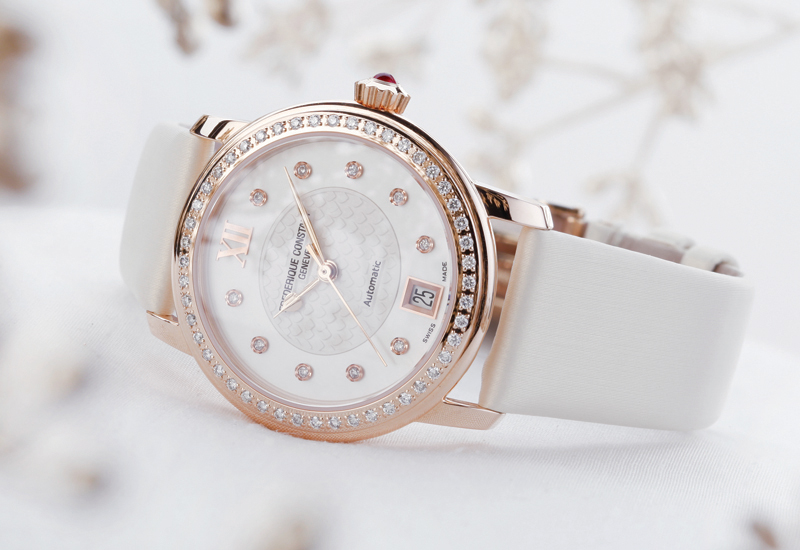
Frederique Constant Automatic Ladies Watch with Diamond features 56 diamonds. Hearts grace the inside of the dial while diamonds are used as hour indicators. It retails for $4,250 and is available at Bloomingdales.com.

The JeanRichard 1681 Collection is available in two versions: one with three hands and a date display, the other with a date display and small second display and in two colors, steel and pink gold. The time display appears against a classical rail-track minute circle. The three-hand version has applied Arabic numerals in a similar style to the hour-markers; the small second display at 9 o’clock counterbalances the date. The oscillating weight of the calibre JR1000, bearing the new signature of the brand, can be seen through the screw-in case-back. The 1681 pictured retails for $6,400 and is available at Kenjo Watches in New York.

Baume & Mercier Linea 10036 ladies watch comes with a double wrap strap in the light brown calfskin, however, there are several other colored bands (single and double) that may be interchanged. The 27mm round watch has a satin finish and a quartz movement. It retails for $1,950 with the interchangeable bands $200 each. Call 1-800-Mercier for purchasing information.

Please join me on the Jewelry News Network Facebook Page, on Twitter @JewelryNewsNet and on the Forbes Web site.

25 Aralık 2013 Çarşamba

Kay Jewelers, one of the U.S. brands
owned by Signet.
Signet Jewelers Ltd., the largest specialty retail jeweler in the U.S. and U.K., said Tuesday that sales for the November-December holiday period rose 7.1 percent to $1.23 billion. Same store sales were up 3.3 percent for the nine-week period.

Strong sales in the U.S. overcame a decline in sales for the company’s U.K. stores. Consolidated e-commerce sales increased by 39 percent, comprised of a 49 percent increase in the U.S. and an 8 percent increase in the U.K. Holiday sales for 2012 did not quite reach the level of growth that the jeweler saw in 2011, which was 7.5 percent.

“We saw particularly strong performance in the weeks and days leading up to Christmas,” said Mike Barnes, Signet CEO. “Business trends continue to be encouraging in the U.S. and have improved in the U.K. after the holiday season.”

The Bermuda-based jewelry retailer owns and operates Kay Jewelers; Jared, the Galleria of Jewelry; and a number of regional brands in the U.S. and H.Samuel and Ernest Jones jewelers in the U.K.

The company’s U.S. division saw a year-over-year sales increase of 9.9 percent to just over $1 billion, compared to an increase of 9.2 percent in the comparable nine weeks. Same store sales for the period increased 4.7 percent led by both Kay and Jared, compared to an increase of 9.2 percent in the comparable nine weeks.
The total sales figure for 2012 includes $37 million from the Chicago-based Ultra Stores retail chain, which Signet acquired in October.
 

“In the U.S. we experienced broad based strength across our merchandise offerings led by our initiatives in bridal, branded and exclusive merchandise, colored diamonds, fashion jewelry and watches,” Barnes said.

Holiday sales in the company’s U.K. division fell by 5 percent to $203.4 million, compared to an increase of 0.9 percent in the comparable nine weeks. Same store sales in the U.K. were down 2.6 percent compared to an increase of 1.8 percent in the comparable nine weeks.

“In the UK watches and branded jewelry were the strongest performers,” Barnes said.

In its outlook, Signet said diluted earnings per share for the fourth quarter are projected at $2.05 to $2.10. Diluted earnings per share for the 53 weeks ending Feb. 2, 2013, are projected at $4.28 to $4.33.

Capital spending for Fiscal 2013 is anticipated to be $138 million to $142 million reflecting current estimates of project timing. In addition to the Ultra Stores, Inc acquisition. Signet says it anticipates 48 new US-based stores for the year.

Please join me on the Jewelry News Network Facebook Page, on Twitter @JewelryNewsNet and on the Forbes Web site.
Jewelry and diamond retailer, Zale Corp., said Thursday that same store sales increased 2.3 percent for the combined months of November and December 2012, encompassing the entire holiday selling period. This increase falls short of the 5.9 percent rise in same store sales for the same period last year. At constant exchange rates, which exclude the effect of translating Canadian currency denominated sales into U.S. dollars, comparable store sales increased 1.6 percent for the holiday selling period, compared to an increase of 6.2 percent in the prior year period.

Revenues for the two-month period were $567 million, an increase of $3 million compared to $564 million in the same period last year. The increase in revenues is primarily due to the same store sales growth partially offset by revenues associated with the net decrease of 50 stores compared to last year.

“This holiday season, we focused on driving bottom line improvement,” said Theo Killion, Zale Corp. CEO. “Our comp performance, combined with an expected 100 basis point operating margin improvement, brings us closer to our goal of achieving positive net income for the fiscal year.”

Holiday selling period same store sales details are as follows:

* Zales branded stores, consisting of Zales Jewelers and Zales Outlet, posted an increase of 3.1 percent, compared to an increase of 10 percent in the same period last year. U.S. fine jewelry brands including regional brand, Gordon’s Jewelers, posted an increase of 2.2 percent. In the same period last year. U.S. fine jewelry brands same store sales rose 9 percent for the 2011 holiday season.

* Canadian Fine Jewelry brands, consisting of Peoples Jewellers and Mappins Jewellers, posted a same store sales increase of 2.7 percent. This increase follows a 0.2 percent rise in the same period last year. At constant exchange rates, Canadian Fine Jewelry brands posted a comparable store sales decline of 0.7 percent, compared to an increase of 1.7 percent in the prior year period.

* Piercing Pagoda, Zale Corp.’s kiosk Jewelry business, posted a same store sales increase of 1.7 percent, compared to a declined 2.1 percent for the 2011 holiday season.

In its outlook for the quarter ending January 31, Zale Corp. said it expects gross margin to be in line with the prior year quarter’s gross margin of 50.5 percent. Operating margin is expected to be approximately 7.5 percent, or 100 basis points higher than the prior year quarter, primarily as a result of improved leverage on selling, general and administrative expenses.

As previously announced, the company expects to achieve positive net income for fiscal year 2013.


Please join me on the Jewelry News Network Facebook Page, on Twitter @JewelryNewsNet and on the Forbes Web site.
Tiffany & Co. said Thursday that worldwide net sales increased 4 percent to $992 million for the November-December holiday period, while same store sales were unchanged from the prior year.

“Holiday period sales growth was at the low-end of our expectations, and we now expect that net earnings for the year ending January 31 will be at the lower-end of the forecast that we issued on November 29 of $3.20 – $3.40 per diluted share,” said Michael J. Kowalski, Tiffany chairman and CEO. “Due to uncertainty about general economic conditions in all our major markets, management is planning sales growth conservatively for 2013 and at this point expects net earnings growth of 6 percent – 9 percent.”

Net sales for the holiday period by region and category include:

Sales in the Americas region increased 3 percent to $516 million in the holiday period. On a constant-exchange-rate basis, total sales increased 2 percent, and same store sales declined 2 percent in the New York flagship store and in branch stores. Performance was relatively similar across much of the region. Internet and catalog sales rose 4 percent.

Sales in the Asia-Pacific region increased 13 percent to $187 million. On a constant-exchange-rate basis, total sales increased 11 percent (due to growth in Greater China and most other markets) and same store sales rose 7 percent.

In Japan, total sales declined 5 percent to $153 million. However, on a constant-exchange-rate basis, both total sales and comparable store sales rose 1 percent.

In Europe, sales increased 2 percent to $119 million due to mixed performances by country. On a constant-exchange-rate basis, total sales also increased 2 percent and same store sales were flat.

Other sales increased 114 percent to $17 million, largely reflecting the conversion in July of five Tiffany stores in the United Arab Emirates from independently-operated distribution to company-operated retail stores.

“Looking forward, we are formulating plans for continued store expansion and new product introductions in 2013,” Kowalski said.

Tiffany currently operates about 274 stores (115 in the Americas, 65 in Asia-Pacific, 55 in Japan, 34 in Europe and five in the U.A.E.), compared with 246 stores (102 in the Americas, 57 in Asia-Pacific, 55 in Japan and 32 in Europe) a year ago.


Please join me on the Jewelry News Network Facebook Page, on Twitter @JewelryNewsNet and on the Forbes Web site.

24 Aralık 2013 Salı


Total holiday retail sales increased 3 percent to $579.8 billion, according to the National Retail Federation. Meanwhile, online sales for the holiday season increased 11.1 percent. Both results were below forecasts.

NRF, the retail trade association projected growth to be 4.1 percent for the two-month holiday period. Shop.org, the multi-channel retail trade association, forecasted a 12 percent growth in online sales for the months of November and December.

Solid consumer spending in the month of December helped retailers finish the year with a healthy holiday shopping season, NRF said. However economic uncertainties sent a cautious consumer to the stores. December retail sales (excluding automobiles, gas stations and restaurants) increased 0.8 percent seasonally adjusted from November and increased 2.1 percent unadjusted year-over-year.

“For over six months, we’ve been saying that the fiscal cliff and economic uncertainty could impact holiday sales. As the number shows, these issues had a visible impact on consumer spending this holiday season,” said Matthew Shay, NRF President and CEO.

December retail sales, released by the U.S. Department of Commerce, showed that retail and food services sales (which include non-general merchandise categories such as automobiles, gasoline stations, and restaurants) increased 0.5 percent seasonally adjusted month-to-month and increased 4.7 percent adjusted year-over-year.

Other findings from the NRF’s December retail sales report include:

• Clothing and clothing accessories stores' sales increased 1 percent seasonally-adjusted month-to-month and increased 2.5 percent unadjusted year-over-year.

• Electronics and appliance stores’ sales decreased 0.6 percent seasonally-adjusted month-to-month and decreased 0.4 percent unadjusted year-over-year.

• Furniture and home furnishing stores’ sales increased 1.4 percent seasonally-adjusted month-to-month and increased 3.0 percent unadjusted year-over-year.

• General merchandise stores’ sales were unchanged seasonally-adjusted month-to-month and decreased 3.4 percent unadjusted year-over-year.

• Health and personal care stores’ sales increased 1.4 percent seasonally-adjusted month-to-month and decreased 0.7 percent unadjusted year-over-year.

• Nonstore retailers’ sales increased 0.5 percent seasonally-adjusted month-to-month and increased 9.6 percent unadjusted year-over-year.

• Sporting goods, hobby, book and music stores’ sales increased 0.6 percent seasonally-adjusted month-to-month and increased 4.7 percent unadjusted year-over-year.

Please join me on the Jewelry News Network Facebook Page, on Twitter @JewelryNewsNet and on the Forbes Web site.

Samuels Jewelers retail chain said same store jewelry sales for the nine-week holiday season were up 8.4 percent, driven by an 11.2 percent increase in December. The season kicked off with a record breaking Black Friday. 

The Austin, Texas-based jewelry retailer operates approximately 104 stores in 22 states primarily in the Southwestern U.S. It is owned by Gitanjali Group, the Mumbai, India-based international diamond and jewelry manufacturer and jewelry retailer. 

“Samuels' strong holiday season sales demonstrate that it has struck the right chord with USA customers yet again,” said Mehul Choksi, Gitanjali Group chairman and managing director. “Customers seeking added value were enchanted by the fresh bouquet of Italian jewelry brands like Giantti and Porrati introduced in stores. The new 97-facet ‘Brilliant Fire’ diamond also found popularity with customers.” 

He added, “With the US market showing signs of stabilizing, we are confident of this trend continuing through the upcoming Valentine season.” 

Please join me on the Jewelry News Network Facebook Page, on Twitter @JewelryNewsNet and on the Forbes Web site.